Pastāsti draugiem par šo preci:
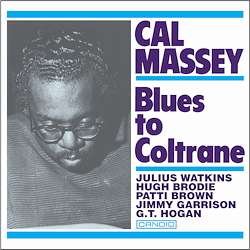
Blues to Coltrane Cal Massey
Mūsu klienti saka:


Blues to Coltrane
Cal Massey
"Blues To Coltrane - Calvin 'Cal' Massey (tp); Julius Watkins (fh); Hugh Brodie (ts); Patti Brown (p); Jimmy Garrison (b); G. T. Hogan (dr)
In examining Massey's life and music, three names continually emerge. One is that of the great tenor saxophonist John Coltrane, whom Massey met as a teenager in Philadelphia and who remained a close friend until his death in 1967. After Coltrane's passing, Massey frequently joined forces with saxophonist, poet, and playwright Archie Shepp; though Shepp was about ten years Massey's junior, the two developed a bond that remained close for the rest of the older man's life. Massey, Coltrane, and Shepp are all linked by the prolific but obscure composer and arranger Romulus Franceschini, who lent his hand to many important jazz projects, such as Coltrane's "Africa/Brass" and Shepp's "Attica Blues". He maintained with Massey a symbiotic relationship not unlike that of Billy Strayhorn and Duke Ellington. On the whole, as in the case of Ellington and Strayhorn, it was difficult to tell where one musician's contribution ended and the other's began.
Massey also shared a radical political stance with Shepp and Franceschini. It is impossible to separate his work from the militant arm of the Civil Rights Movement that took shape in the 1960s and 1970s. As Fred Ho has noted, »Titles such as "[Hey Goddamn It]", "Things Have Got To Change", "The Damned Don't Cry", and "The Cry Of My People" spoke directly to a consciousness of oppression and a politics of liberation.« In fact, the Black Panthers were a driving force behind Massey's creation (with Franceschini) of "The Black Liberation Movement Suite". At the first Pan-African Arts Festival in Algiers in 1969 Massey met exiled Panthers leader Eldridge Cleaver who commissioned the Suite primarily as a fundraising venture. The work would be performed at Black Panther benefits three times during Massey's lifetime.
Massey paid heavy dues for his adventurous music and ideology, as did many of his contemporaries. According to his widow, an altercation with an executive at Blue Note Records resulted in his being blacklisted (or, as Fred Ho put it, »whitelisted«) from major recording companies. As a result, only one album was recorded under his name, "Blues To Coltrane", recorded 1961 and released 1987.
Massey died from a heart attack at the age of 44 in New York City, New York. October 25, 1972.
| Mediji | Mūzika VINYL LP (Vinils) |
| Ierakstu skaits | 1 |
| Izlaists | 2019. gada 16. augusts |
| EAN/UPC | 5060149622995 |
| Izdevniecība | PURE PLEASURE PUPE9029.1 |
| Žanrs | Jazz |
| Izmēri | 311 × 313 × 4 mm · 297 g |
Dziesmu saraksts
-
- Blues to Coltrane
- What's Wrong?
- Bakai
- These Are Soulful Days
- Father and Son
Vairāk no tā paša izdevēja

![Cover for Shorty Rogers · Jazz Waltz (LP) [Audiophile edition] (2026)](https://imusic.b-cdn.net/images/item/original/629/5060149622629.jpg?shorty-rogers-2026-jazz-waltz-lp&class=scaled&v=1514972518)
![Cover for Cassandra Wilson · Belly Of The Sun (LP) [Audiophile edition] (2026)](https://imusic.b-cdn.net/images/item/original/653/5060149621653.jpg?cassandra-wilson-2026-belly-of-the-sun-lp&class=scaled&v=1557134777)

![Cover for Mel Lewis Thad Jones · Consummation (LP) [180 Gram Audiophile edition] (2026)](https://imusic.b-cdn.net/images/item/original/486/5060149621486.jpg?mel-lewis-thad-jones-2026-consummation-lp&class=scaled&v=1577518001)


![Cover for Melvin & The Slack Band Taylor · Melvin Taylor & The Slack Band (LP) [Audiophile edition] (2024)](https://imusic.b-cdn.net/images/item/original/718/5060149623718.jpg?melvin-the-slack-band-taylor-2024-melvin-taylor-the-slack-band-lp&class=scaled&v=1703242453)
![Cover for John Stubblefield · Bushman Song (LP) [Limited edition] (2023)](https://imusic.b-cdn.net/images/item/original/640/5060149623640.jpg?john-stubblefield-2023-bushman-song-lp&class=scaled&v=1691755960)
![Cover for David Murry Power Quartet · Lucky Four (LP) [Remastered edition] (2023)](https://imusic.b-cdn.net/images/item/original/657/5060149623657.jpg?david-murry-power-quartet-2023-lucky-four-lp&class=scaled&v=1696332671)
![Cover for Phil Ranelin · Time Is Now (LP) [Remastered edition] (2023)](https://imusic.b-cdn.net/images/item/original/872/5060149622872.jpg?phil-ranelin-2023-time-is-now-lp&class=scaled&v=1550234007)
![Cover for Norman Connors · Dance Of Magic (LP) [Pure Pleasure edition] (2023)](https://imusic.b-cdn.net/images/item/original/534/5060149623534.jpg?norman-connors-2023-dance-of-magic-lp&class=scaled&v=1682168057)
![Cover for Louis & His All Sta Armstrong · Plays W.C. Handy (LP) [180 gram edition] (2023)](https://imusic.b-cdn.net/images/item/original/250/5060149620250.jpg?louis-his-all-sta-armstrong-2023-plays-w-c-handy-lp&class=scaled&v=1449053625)
![Cover for Nat King Cole · After Midnight (LP) [Pure Pleasure edition] (2023)](https://imusic.b-cdn.net/images/item/original/236/5060149620236.jpg?nat-king-cole-2023-after-midnight-lp&class=scaled&v=1194284575)
![Cover for Randy Crawford · Raw Silk (LP) [Pure Pleasure edition] (2023)](https://imusic.b-cdn.net/images/item/original/117/5060149622117.jpg?randy-crawford-2023-raw-silk-lp&class=scaled&v=1425835820)


![Cover for Joe Turner · Boss Of The Blues (LP) [Pure Pleasure edition] (2022)](https://imusic.b-cdn.net/images/item/original/209/5060149622209.jpg?joe-turner-2022-boss-of-the-blues-lp&class=scaled&v=1597482507)
![Cover for Sidney Bechet · The Grand Master Of The Soprano Saxophone (LP) [Remastered, Audiophile edition] (2022)](https://imusic.b-cdn.net/images/item/original/476/5060149622476.jpg?sidney-bechet-2022-the-grand-master-of-the-soprano-saxophone-lp&class=scaled&v=1498995944)
![Cover for Otis Rush · Right Place Wrong Time (LP) [Audiophile edition] (2022)](https://imusic.b-cdn.net/images/item/original/684/5060149621684.jpg?otis-rush-2022-right-place-wrong-time-lp&class=scaled&v=1447759467)
![Cover for Keb'Mo' · Suitcase (LP) [Pure Pleasure edition] (2022)](https://imusic.b-cdn.net/images/item/original/455/5060149621455.jpg?keb-mo-2022-suitcase-lp&class=scaled&v=1364598747)
![Cover for Charles Mingus · East Coasting (LP) [Pure Pleasure edition] (2022)](https://imusic.b-cdn.net/images/item/original/974/5060149621974.jpg?charles-mingus-2022-east-coasting-lp&class=scaled&v=1409288899)
![Cover for Horace Tapscott · Dial 'b' for Barbra (LP) [Audiophile edition] (2021)](https://imusic.b-cdn.net/images/item/original/374/5060149623374.jpg?horace-tapscott-2021-dial-b-for-barbra-lp&class=scaled&v=1617810260)

![Cover for Wendell -Tribe- Harrison · Get Up Off Your Knees (LP) [180 gram edition] (2021)](https://imusic.b-cdn.net/images/item/original/497/5060149623497.jpg?wendell-tribe-harrison-2021-get-up-off-your-knees-lp&class=scaled&v=1633700223)
![Cover for Horace Tapscott · Live At Lobero Vol. 2 (LP) [Limited edition] (2021)](https://imusic.b-cdn.net/images/item/original/220/5060149623220.jpg?horace-tapscott-2021-live-at-lobero-vol-2-lp&class=scaled&v=1647563615)
![Cover for Ben Webster · Live At Pio's (LP) [Pure Pleasure edition] (2021)](https://imusic.b-cdn.net/images/item/original/442/5060149623442.jpg?ben-webster-2021-live-at-pio-s-lp&class=scaled&v=1646216854)
![Cover for Farrah,shamek / Smith,sonelius · World of the Children (LP) [Limited edition] (2021)](https://imusic.b-cdn.net/images/item/original/282/5060149623282.jpg?farrah-shamek-smith-sonelius-2021-world-of-the-children-lp&class=scaled&v=1615489952)

![Cover for Nate Morgan · Journey Into Nigritia (LP) [Audiophile edition] (2021)](https://imusic.b-cdn.net/images/item/original/428/5060149623428.jpg?nate-morgan-2021-journey-into-nigritia-lp&class=scaled&v=1620401343)
Citi arī iegādājušies







Skatīt visus Cal Massey ( piem., CD , Paperback Book un LP )