Pastāsti draugiem par šo preci:
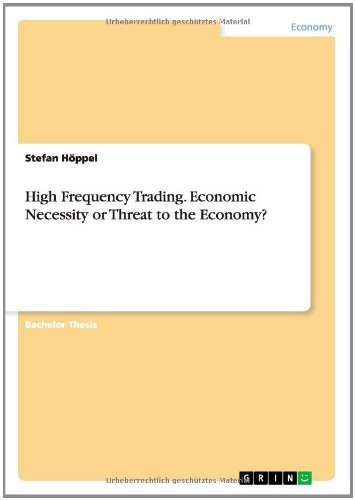
High Frequency Trading. Economic Necessity or Threat to the Economy? Stefan Höppel
Pasūtīts no attālās noliktavas
 Ziemassvētku dāvanas var atgriezt līdz 31. janvārim

Mūsu klienti saka:


High Frequency Trading. Economic Necessity or Threat to the Economy?
Stefan Höppel
Bachelor Thesis from the year 2013 in the subject Economics - Finance, grade: 1,00, Universities of Applied Sciences Wien (FH-Wien University of Applied Sciences), course: Financial Management, language: English, abstract: In the last four decades, technological progress led to an electrification of stock trading systems. Traders were enabled to place their orders, which were later processed via electronic networks, with the help of computers. Soon they realized that the profitability of trading strategies could be increased by employing computer algorithms to trade autonomously, reducing time needed to analyze information, publish quotes as well as trigger and process trades. This led to the implementation of Algorithmic Trading (AT). High Frequency Trading (HFT) is a subset of AT, at which financial instruments are traded by algorithms at very high speed. The past has shown that negative developments on capital markets are intensified by HFT. Andrei Kirilenko explains in his work "The Flash Crash: The Impact of High Frequency Trading on an Electronic Market" that HFT did not trigger the Flash Crash but intensified the volatility that resulted from the event. Also on the 19th of October 1987, "Black Monday", the increasing computerization of stock trading processes led to a significant price drop. As a consequence, the high and still growing market share of HFT leads to an increase in risk that a simple correction turns into a serious drop in prices causing market instability. Theoretically HFT should increase efficiency in financial markets. However, due to the empirical observation mentioned above, it seems that HFT takes effect the other way round. It seems that, at least under certain circumstances, HFT enlarges volatility. This cannot be explained by the economic neoclassical theory. This problem is discussed in a lot of literature in which several different approaches have been made to explain it. The aim of this paper is to discuss why HFT cannot be fully e
| Mediji | Grāmatas Paperback Book (Grāmata ar mīksto vāku un līmēto muguru) |
| Izlaists | 2014. gada 17. februāris |
| ISBN13 | 9783656579687 |
| Izdevēji | GRIN Verlag GmbH |
| Lapas | 48 |
| Izmēri | 146 × 3 × 207 mm · 84 g |
| Valoda | Vācu |
