Pastāsti draugiem par šo preci:
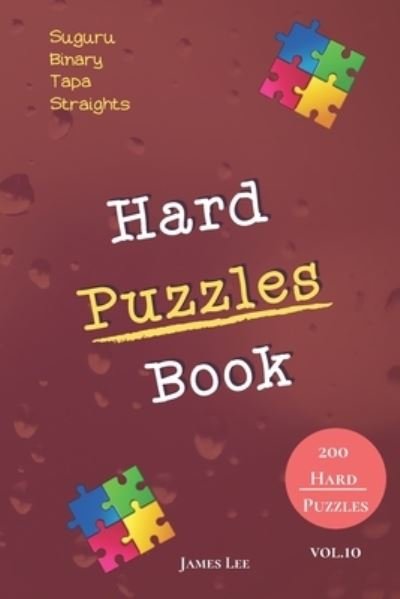
Hard Puzzles Book - Suguru, Binary, Tapa, Straights - 200 Hard Puzzles vol.10 James Lee
Mūsu klienti saka:


Hard Puzzles Book - Suguru, Binary, Tapa, Straights - 200 Hard Puzzles vol.10
James Lee
-Suguru, also known as Tectonics or Number Blocks, is a Japanese puzzle invented by Naoki Inaba. The goal is to fill a given rectangular grid with numbers, so that every designated area contains a sequence of non-repeating, consecutive numbers, starting from 1 and going up. Also, adjacent (touching) cells should not contain the same number, even diagonally.-Binary (also known as "Binairo Puzzle", "Takuzu", "Tohu wa Vohu") is played on a rectangular or square grid. The goal is to fill in the grid with digits "0" and "1" according to the following rules: Each box should contain a zero or a one. No more than two similar numbers next to or below each other are allowed. Each row and each column should contain an equal number of zeros and ones (or one more for odd sized grids). Each row is unique, and each column is unique.-Tapa is a logic puzzle. The goal is to blacken some cells of the grid. Shade some empty cells black to create a single connected wall. Numbers in a cell indicate the length of consecutive shaded blocks in the neighboring cells. If there is more than one number in a cell, then there must be at least one white (unshaded) cell between the black cell groups. Cells with numbers cannot be shaded, and the shaded cells cannot form a 2×2 square anywhere in the grid. Question marks can be used instead of clue numbers. Each question mark can represent any nonzero integer.-(Straights) The solver is given a 9x9 grid, partially divided by black cells into compartments. Each compartment, vertically or horizontally, must contain a straight - a set of consecutive numbers, but in any order. For example: 7, 6, 4, 5 is valid, but 1, 3, 8, 7 is not. Like sudoku, the solver must fill the remaining white cells with numbers 1 to 9 (or 1 to n in puzzles with N cells per side) such that each row and column contains unique digits. Whereas Sudoku has the additional constraint of 3x3 boxes, in Str8ts rows and columns are divided by blacks cells. Additional clues are set in some of the black cells - these numbers remove that digit as an option in the row and column. Such digits do not form part of any straight.
| Mediji | Grāmatas Paperback Book (Grāmata ar mīksto vāku un līmēto muguru) |
| Izlaists | 2019. gada 12. decembris |
| ISBN13 | 9781674638188 |
| Lapas | 120 |
| Izmēri | 152 × 229 × 6 mm · 172 g |
| Valoda | Angļu |








![Cover for James Lee · Beginning Perl (Paperback Book) [3rd edition] (2010)](https://imusic.b-cdn.net/images/item/original/939/9781430227939.jpg?james-lee-2010-beginning-perl-paperback-book&class=scaled&v=1420741064)
