Pastāsti draugiem par šo preci:
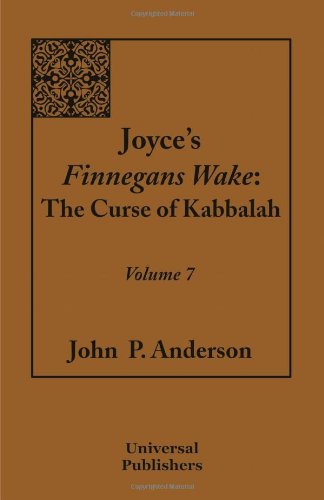
Joyce's Finnegans Wake: the Curse of Kabbalah Volume 7 John P. Anderson
Pasūtīts no attālās noliktavas
 Ziemassvētku dāvanas var atgriezt līdz 31. janvārim

Mūsu klienti saka:


Joyce's Finnegans Wake: the Curse of Kabbalah Volume 7
John P. Anderson
This seventh in a series continues this non-academic author's ground-breaking word-by-word analysis of James Joyce's Finnegans Wake. This volume covers chapters 2.4, 3.1 and 3.2 with the intent to explore them as art objects. In Chapter 2.4 spirit imperialists attack love. Love, particularly the spontaneous kind, is an outpost of freedom and more possibilities. That outpost is a threat to the status quo regime of the imperialists and puts its central committee on alert. The imperialist control effort focuses on the two main sources of spontaneous love, the natural nurturing tendency of human females and the giving spirit of Jesus. One pure expression of this kind of control is the arranged marriage, an institution that often serves political interests. In arranged marriages, control trumps love. The arranged part of the marriage is usually the female. The arranged marriage makes spontaneous love illicit. This chapter presents love suffering from control in the context of two arranged marriages: Joyce's version of Isolde to King Mark in Tristan and Isolde ["T&I"] and Jesus to the church in the Gospels. The result in both cases is the same: love fused to death and a relationship barren of new offspring. The spirit mates in this chapter are King Mark from T&I and Evangelist Mark. The Book of Mark as edited reduced the independent and loving Christ to the "suffering servant," and Tristan died at the Cliff of Penmark, just as the real Christ died at the pen of Mark. Editors, the hated object of Joyce's early life as an author, fuse the stories. Another common element in the themes is the threat of the new replacing the old: Tristan replacing King Mark and the Son religion replacing the Father religion. This threat is announced at the opening of chapter 2.4. Part 3 brings us Shaun's chapters, chapters that feature his spirit. He is exhibited as a spirit imperialist in marching pants stained by an anal retentive childhood experience outlined in earlier chapters. He is stuck in the past, to influences from the past. Put another way and more to the point, the past is stuck in him. In Joyce's images, he has remained subject to the "son" or past family experiences in his soul and has not arisen to the independent "sun" in the present. Their dream character connects these Part 3 chapters to the altered mind state that produced the Book of Revelations, the source of formal elegance for these chapters. Shaun is cast in the mould of the closed spirit of the Anti-Christ [AC] and Shem in the mould of the open spirit of Christ [C]. Following the forehead allegiance indicator used in Revelations, these two chapters end after Shaun/Jaun puts a postage stamp on his forehead, he as the envelope of a message from others. His message is fear of unrestricted life possibilities because of its sufferings. His postage stamp is yellow for fear, but he has no spirit of his own, no message of his own to deliver. By contrast, Shem's spirit has risen within himself from dependence to independence, like the phoenix bird of myth that creates itself young from its own ashes. That mythical ascent ends chapter 3.2.
| Mediji | Grāmatas Paperback Book (Grāmata ar mīksto vāku un līmēto muguru) |
| Izlaists | 2013. gada 15. janvāris |
| ISBN13 | 9781612331898 |
| Izdevēji | Universal Publishers |
| Lapas | 512 |
| Izmēri | 140 × 216 × 26 mm · 585 g |
| Valoda | Angļu |
Vairāk no John P. Anderson





Vairāk no šīs sērijas
Vairāk no tā paša izdevēja


![Cover for John N Hatzopoulos · Topographic Mapping: Covering the Wider Field of Geospatial Information Science & Technology (GIS&T) SECOND EDITION (Paperback Book) [2nd edition] (2024)](https://imusic.b-cdn.net/images/item/original/852/9781627344852.jpg?john-n-hatzopoulos-2024-topographic-mapping-covering-the-wider-field-of-geospatial-information-science-technology-gis-t-second-edition-paperback-book&class=scaled&v=1746740559)


Skatīt visus John P. Anderson