Pastāsti draugiem par šo preci:
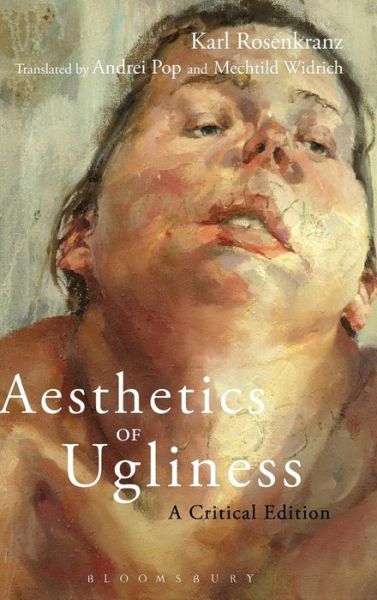
Aesthetics of Ugliness: A Critical Edition Karl Rosenkranz
Pasūtīts no attālās noliktavas
 Ziemassvētku dāvanas var atgriezt līdz 31. janvārim

Mūsu klienti saka:


Aesthetics of Ugliness: A Critical Edition
Karl Rosenkranz
Marc Notes: Translated from the German.; Treating phenomena from the sublime to the comic in visual art and literature from the Greeks to Eugene Sue, Karl Rosenkranz, the student and critic of Hegel, shows ugliness to be the negation of beauty without being reducible to evil, materiality, or other negative terms used in the conventional condemnation of ugliness. This insistence on the specificity of ugliness, and on its dynamic status as a process afflicting aesthetic canons, reflects Rosenkranz's interest in the metropolis - like Walter Benjamin, he wrote on Paris and Berlin - and his voracious collecting of caricature and popular prints. Rosenkranz, living and teaching, like Kant, in remote Konigsberg, reflects on phenomena of modern urban life from a distance that results in critical illumination. Biographical Note: Karl Rosenkranz (1805 -1879) was a German philosopher. He followed Kant and Herbart as professor of philosophy in Konigsberg; in 1848-49 he took part in the reform government in Berlin. Andrei Pop is Associate Professor in the John U. Nef Committee on Social Thought at the University of Chicago. Mechtild Widrich is Assistant Professor of Contemporary Art History in the School of the Art Institute of Chicago, USA."Table of Contents: Table of Contents: 1. Introductory essay by Andrei Pop and Mechtild Widrich2. Karl Rosenkranz, Aesthetics of Ugliness, 18533. The Text: IntroductionSection 1Section 2Section 3ConclusionRosenkranz's and editors' notes4. Texts crucial to the understanding of the Aesthetics of Ugliness: i) Rosenkranz's review of Hegel's Aesthetics, 1836 and 1839ii) Rosenkranz's entry on "Aesthetics in its Development" in the Brockhaus Conversation-Lexikon, 1838iii) Rosenkranz, "Beauty and Art" section of his System of Science, 1850BibliographyIndexPublisher Marketing: In this key text in the history of art and aesthetics, Karl Rosenkranz shows ugliness to be the negation of beauty without being reducible to evil, materiality, or other negative terms used it's conventional condemnation. This insistence on the specificity of ugliness, and on its dynamic status as a process afflicting aesthetic canons, reflects Rosenkranz's interest in the metropolis - like Walter Benjamin, he wrote on Paris and Berlin - and his voracious collecting of caricature and popular prints. Rosenkranz, living and teaching, like Kant, in remote Konigsberg, reflects on phenomena of modern urban life from a distance that results in critical illumination. The struggle with modernization and idealist aesthetics makes "Aesthetics of Ugliness," published four years before Baudelaire's "Fleurs du Mal," hugely relevant to modernist experiment as well as to the twenty-first century theoretical revival of beauty. Translated into English for the first time, "Aesthetics of Ugliness" is an indispensable work for scholars and students of modern aesthetics and modernist art, literary studies and cultural theory, which fundamentally reworks conceptual understandings of what it means for a thing to be ugly." Contributor Bio: Rosenkranz, Karl Karl Rosenkranz (1805 a "1879) was a German philosopher. He followed Kant and Herbart as professor of philosophy in KAnigsberg, Germany. A lifelong defender of the philosophy of Hegel, he participated briefly in the post-1848 reform government in Berlin. Contributor Bio: Pop, Andrei Karl Rosenkranz (1805 a "1879) was a German philosopher. He followed Kant and Herbart as professor of philosophy in KAnigsberg, Germany. A lifelong defender of the philosophy of Hegel, he participated briefly in the post-1848 reform government in Berlin. Contributor Bio: Widrich, Mechtild Karl Rosenkranz (1805 a "1879) was a German philosopher. He followed Kant and Herbart as professor of philosophy in KAnigsberg, Germany. A lifelong defender of the philosophy of Hegel, he participated briefly in the post-1848 reform government in Berlin.
| Mediji | Grāmatas Hardcover Book (Grāmata ar cieto muguriņu un vāku) |
| Izlaists | 2015. gada 30. jūlijs |
| ISBN13 | 9781472568854 |
| Izdevēji | Bloomsbury Publishing PLC |
| Lapas | 344 |
| Izmēri | 156 × 234 × 21 mm · 681 g |
| Valoda | Angļu |
| Tulks | Pop, Andrei |
| Tulks | Widrich, Mechtild |
![Cover for Karl Rosenkranz · Geschichte Der Kant'schen Philosophie - Philosophiehistorische Texte (Hardcover Book) [Reprint 2024 edition] (1987)](https://imusic.b-cdn.net/images/item/original/984/9783112729984.jpg?karl-rosenkranz-1987-geschichte-der-kant-schen-philosophie-philosophiehistorische-texte-hardcover-book&class=scaled&v=1770853688)