Pastāsti draugiem par šo preci:
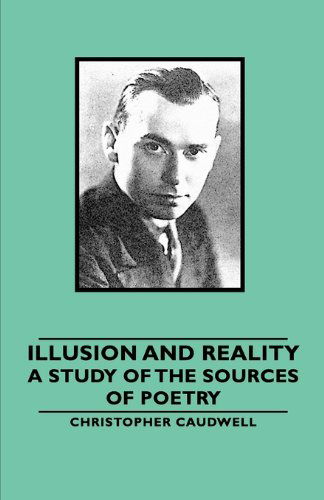
Illusion and Reality: a Study of the Sources of Poetry Christopher Caudwell Annotated edition
Pasūtīts no attālās noliktavas
Mūsu klienti saka:


Pieejams arī kā:
Illusion and Reality: a Study of the Sources of Poetry
Christopher Caudwell
ILLUSION AND REALITY A STUDY OF THE SOURCES OF POETRY By CHRISTOPHER CAUDWELL CONTENTS BIOGRAPHICAL NOTE INTRODUCTION THE BIRTH OF POETRY THE DEATH OF MYTHOLOGY THE INVOLVMENT OF MODERN POETRY ENGLISH POETS: I PRIMITIVE ACCUMULATION II THE INDUSTRIAL REVOLUTION III DECLINE OF CAPITALISM THE WORLD THE PHANTASY POETRYS DREAMWORK THE ARTS THE FUTURE OF POETRY..... BIBLIOGRAPHY INDEX BIOGRAPHICAL NOTE THIS is one of the great books of our time. It is not easy reading. It is a book to be studied and annotated and returned to again and again. The reader will then find that, however often he takes it up, it will always give him fresh food for thought. The author, Christopher St. John Sprigg, was born in Putney on October 20, 1907. He was educated at the Benedictine school at Ealing. He left school at sixteen and a half and worked for three years as a reporter on the Yorkshire Observer. Then he returned to London and joined a firm of aeronautical publishers, first as editor and later as a director. He invented an infinitely variable gear, the designs for which were published in the Automobile Engineer. They attracted a good deal of attention from experts. He published five textbooks on aero nautics, seven detective novels, and some poems and short stories. All this before he was twentyfive. In May, 1935, under the name of Christopher Caudwell, he published his first serious novel, This My Hand. It shows that lie had made a close study of psychology, but he had not yet succeeded in relating his knowledge to life. At the end of 1934 he had come across some of the Marxist classics, and the following summer he spent in Cornwall immersed in the works of Marx, Engcls, and Lenin, Shortly after his return to London he finished the first draft of Illusion and Reality. Then, in December, he took lodgings in Poplar and later joined the Poplar Branch of the Communist Party. Many of his Poplar comrades were dockers, almost aggressively proletarian, and a little suspicious at first of the,quiet, well spoken young man who wrote books for a living out before long he was accepted as one of themselves, doing his share of whatever had to be done. A few months after joining the Party he went over to Paris to get a firsthand experience of the Popular Front and he came back with renewed energy and enthusiasm. Besides continuing to write novels for a living, he rewrote Illusion and Reality, completed . the essays published subsequently as Studies in a Dying Culture, and began The. Crisis in Physics. He worked to the clock. After spending the day at his typewriter, he would leave the house at five and go out to the Branch to speak at an openair meeting, or sell the Daily Worker at the corner of Crisp Street Market. . Meanwhile, the Spanish Civil War had broken out. The Poplar Branch threw itself into the campaign, with Caudwell as one of the leading spirits. By November they had raised enough money to buy an ambulance, and Caudwell was chosen to drive it across France.
| Mediji | Grāmatas Paperback Book (Grāmata ar mīksto vāku un līmēto muguru) |
| Izlaists | 2006. gada 24. maijs |
| ISBN13 | 9781846649141 |
| Izdevēji | Obscure Press |
| Lapas | 276 |
| Izmēri | 150 × 220 × 10 mm · 353 g |
| Valoda | Angļu |


![Cover for Christopher Caudwell · Studies and Further Studies in a Dying Culture (Paperback Book) [New edition] (1971)](https://imusic.b-cdn.net/images/item/original/188/9780853452188.jpg?christopher-caudwell-1971-studies-and-further-studies-in-a-dying-culture-paperback-book&class=scaled&v=1505472825)