Pastāsti draugiem par šo preci:
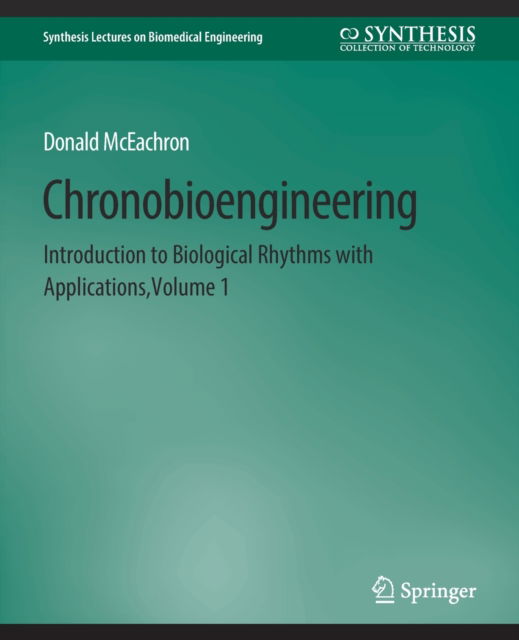
Chronobioengineering: Introduction to Biological Rhythms with Applications (Volume 1) Donald Mceachron
Mūsu klienti saka:


Chronobioengineering: Introduction to Biological Rhythms with Applications (Volume 1)
Donald Mceachron
**This is the full color version of the book**
This book represents the first in a two-volume set on biological rhythms. This volume focuses on supporting the claim that biological rhythms are universal and essential characteristics of living organisms, critical for proper functioning of any living system. The author begins by examining the potential reasons for the evolution of biological rhythms: (1) the need for complex, goal-oriented devices to control the timing of their activities; (2) the inherent tendency of feedback control systems to oscillate; and (3) the existence of stable and powerful geophysical cycles to which all organisms must adapt. To investigate the second reason, the author enlists the help of biomedical engineering students to develop mathematical models of various biological systems. One such model involves a typical endocrine feedback system. By adjusting various model parameters, it was found that creating a oscillation in any component of the model generated a rhythmic cascade that made the entire system oscillate. This same approach was used to show how daily light/dark cycles could cascade rhythmic patterns throughout ecosystems and within organisms. Following up on these results, the author discusses how the twin requirements of internal synchronization (precise temporal order necessary for the proper functioning of organisms as complex, goal-oriented devices) and external synchronization (aligning organisms' behavior and physiology with geophysical cycles) supported the evolution of biological clocks. The author then investigates the clock systems that evolved using both conceptual and mathematical models, with the assistance of Dr. Bahrad Sokhansanj, who contributes a chapter on mathematical formulations and models of rhythmic phenomena. With the ubiquity of biological rhythms established, the author suggests a new classification system: the F4LM approach (Function; Frequency; waveForm; Flexibility; Level of biological system expressing rhythms; and Mode of rhythm generation) to investigate biological rhythms. This approach is first used on the more familiar cardiac cycle and then on neural rhythms as exemplified and measured by the electroencephalogram. During the process of investigating neural cycles, the author finds yet another reason for the evolution of biological rhythms: physical constraints, such as those imposed upon long distance neural signaling. In addition, a common theme emerges of a select number of autorhythmic biological oscillators imposing coherent rhythmicity on a larger network or system. During the course of the volume, the author uses a variety of observations, models, experimental results, and arguments to support the original claim of the importance and universality of biological rhythms. In Volume 2, the author will move from the establishment of the critical nature of biological rhythms to how these phenomena may be used to improve human health, well-being, and productivity. In a sense, Volume 1 focuses on the chronobio aspect of chronobioengineering while Volume 2 investigates methods of translating this knowledge into applications, the engineering aspect of chronobioengineering. Table of Contents: Time and Time Again / Walking on Air: An Empirical Proof-of-Concept / Clock Tech, Part 1 / Clock Tech II From External to Internal Timers / Clock Tech III Rise of the CircaRhythms / The Circle Game: Mathematics, Models, and Rhythms / The Power of Circular Reasoning
| Mediji | Grāmatas Paperback Book (Grāmata ar mīksto vāku un līmēto muguru) |
| Izlaists | 2012. gada 1. novembris |
| ISBN13 | 9781598296372 |
| Izdevēji | Morgan & Claypool Publishers |
| Lapas | 286 |
| Izmēri | 191 × 235 × 15 mm · 498 g |
| Valoda | Angļu |


![Cover for Joshua Colwell · The Ringed Planet: Cassini's Voyage of Discovery at Saturn - IOP Concise Physics (Paperback Book) [2 Revised edition] (2019)](https://imusic.b-cdn.net/images/item/original/110/9781643277110.jpg?joshua-colwell-2019-the-ringed-planet-cassini-s-voyage-of-discovery-at-saturn-iop-concise-physics-paperback-book&class=scaled&v=1605099497)
![Cover for Joshua Colwell · The Ringed Planet: Cassini's Voyage of Discovery at Saturn (Hardcover Book) [2 Revised edition] (2019)](https://imusic.b-cdn.net/images/item/original/158/9781643277158.jpg?joshua-colwell-2019-the-ringed-planet-cassini-s-voyage-of-discovery-at-saturn-hardcover-book&class=scaled&v=1604028982)