Pastāsti draugiem par šo preci:
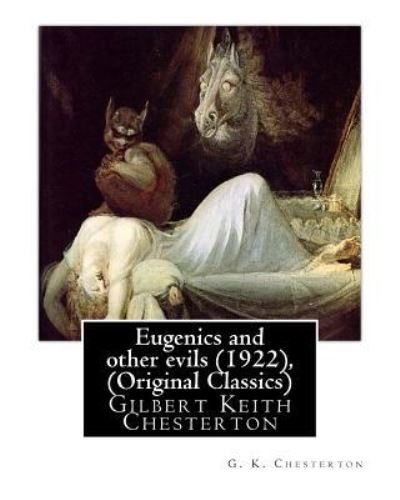
Eugenics and Other Evils (1922), by G. K. Chesterton (Original Classics) G K Chesterton
Pasūtīts no attālās noliktavas
Mūsu klienti saka:


Eugenics and Other Evils (1922), by G. K. Chesterton (Original Classics)
G K Chesterton
To the Reader Part 1: The False Theory Chapter I: What is Eugenics? Chapter II: The First Obstacles Chapter III: The Anarchy from Above Chapter IV: The Lunatic and the Law Chapter V: The Flying Authority Chapter VI: The Unanswered Challenge Chapter VII: The Established Church of Doubt Chapter VIII: A Summary of a False Theory Part 2: The Real Aim Chapter I: The Impotence of Impenitence Chapter II: True History of a Tramp Chapter III: True History of a Eugenist Chapter IV: The Vengeance of the Flesh Chapter V: The Meanness of the Motive Chapter VI: The Eclipse of Liberty Chapter VII: The Transformation of Socialism Chapter VIII: The End of the Household Gods Chapter IX: A Short Chapter Gilbert Keith Chesterton, (29 May 1874 - 14 June 1936), better known as G. K. Chesterton, was an English writer, poet, philosopher, dramatist, journalist, orator, lay theologian, biographer, and literary and art critic. Chesterton is often referred to as the "prince of paradox."Time magazine has observed of his writing style: "Whenever possible Chesterton made his points with popular sayings, proverbs, allegories-first carefully turning them inside out."Chesterton is well known for his fictional priest-detective Father Brown, and for his reasoned apologetics. Even some of those who disagree with him have recognized the wide appeal of such works as Orthodoxy and The Everlasting Man. Chesterton, as a political thinker, cast aspersions on both Progressivism and Conservatism, saying, "The whole modern world has divided itself into Conservatives and Progressives. The business of Progressives is to go on making mistakes. The business of the Conservatives is to prevent the mistakes from being corrected."Chesterton routinely referred to himself as an "orthodox" Christian, and came to identify this position more and more with Catholicism, eventually converting to Catholicism from High Church Anglicanism. George Bernard Shaw, Chesterton's "friendly enemy" according to Time, said of him, "He was a man of colossal genius."Biographers have identified him as a successor to such Victorian authors as Matthew Arnold, Thomas Carlyle, Cardinal John Henry Newman, and John Ruskin. Early life Chesterton was born in Campden Hill in Kensington, London, the son of Marie Louise, née Grosjean, and Edward Chesterton. He was baptized at the age of one month into the Church of England, though his family themselves were irregularly practising Unitarians. According to his autobiography, as a young man Chesterton became fascinated with the occult and, along with his brother Cecil, experimented with Ouija boards. Chesterton was educated at St Paul's School, then attended the Slade School of Art in order to become an illustrator. The Slade is a department of University College London, where Chesterton also took classes in literature, but did not complete a degree in either subject.....
| Mediji | Grāmatas Paperback Book (Grāmata ar mīksto vāku un līmēto muguru) |
| Izlaists | 2016. gada 20. jūlijs |
| ISBN13 | 9781535392389 |
| Izdevēji | Createspace Independent Publishing Platf |
| Lapas | 74 |
| Izmēri | 203 × 254 × 4 mm · 163 g |
| Valoda | Angļu |