
Pastāsti draugiem par šo preci:
The Lion of Petra Talbot Mundy
 Ziemassvētku dāvanas var atgriezt līdz 31. janvārim

Mūsu klienti saka:


Pieejams arī kā:
The Lion of Petra
Talbot Mundy
Publisher Marketing: "Allah Makes All Things Easy!" This isn't an animal story. No lions live at Petra nowadays, at any rate, no four-legged ones; none could have survived competition with the biped. Unquestionably there were tamer, gentler, less assertive lions there once, real yellow cats with no worse inconveniences for the casual stranger than teeth, claws, and appetites. The Assyrian kings used to come and hunt near Petra, and brag about it afterward; after you have well discounted the lies they made their sculptors tell on huge stone monoliths when they got back home, they remain a pretty peppery line of potentates. But for imagination, self-esteem, ambition, gall, and picturesque depravity they were children-mere chickens-compared to the modern gentleman whom Grim and I met up with A. D. 1920. You can't begin at the beginning of a tale like this, because its roots reach too far back into ancient history. If, on the other hand, you elect to start at the end and work backward the predicament confronts you that there wasn't any end, nor any in sight. As long as the Lion of Petra has a desert all about him and a choice of caves, a camel within reach, and enough health to keep him feeling normal-never mind whose camel it is, nor what power claims to control the desert-there will be trouble for somebody and sport for him. So, since it can have no end and no beginning, you might define this as an episode-a mere interval between pipes, as it were, in the amusing career of Ali Higg ben Jhebel ben Hashim, self-styled Lion of Petra, Lord of the Wells, Chief of the Chiefs of the Desert, and Beloved of the Prophet of Al-Islam; not forgetting, though, that his career was even supposed to amuse his victims or competitors. The fun is his, the fury other people's. Contributor Bio: Mundy, Talbot Talbot Mundy (born William Lancaster Gribbon) (April 23, 1879 - August 5, 1940) was an English writer. He also wrote under the pseudonym Walter Galt. Born in London, at age 16 he ran away from home and began an odyssey in India, Africa, and other parts of the Near and Far East. By age 29, he had begun using the name Talbot Mundy, and a year later arrived in the United States, starting his writing career in 1911. His novel King of the Khyber Rifles is set in India under British Occupation. The long buildup to the introduction to Yasmini and the scenes among the outlaws in the Khinjan Caves clearly influenced fantasy writers Robert E. Howard and Leigh Brackett. His related Jim Grim series, which has mystical overtones and part of which is available over the web from theosophical sites, ran in Adventure magazine before book publication. Mundy was associated with Theosophy's movement and helped popularize the legend of the Nine Unknown Men in the West. He wrote many other books and stories, including Hira Singh and a number of stories about Tros of Samothrace, a Greek freedom fighter who aided Britons and Druids in their fight against Julius Caesar.
| Mediji | Grāmatas Paperback Book (Grāmata ar mīksto vāku un līmēto muguru) |
| Izlaists | 2014. gada 7. jūlijs |
| ISBN13 | 9781500342159 |
| Izdevēji | Createspace |
| Lapas | 102 |
| Izmēri | 152 × 229 × 5 mm · 145 g |


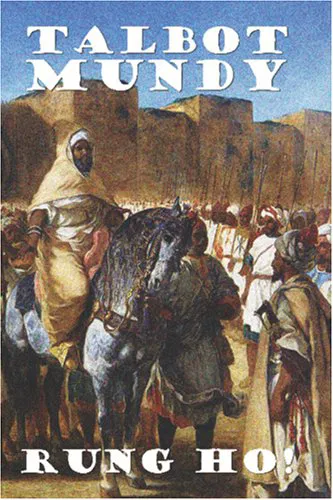


![Cover for Talbot Mundy · Rung Ho [Facsimile Edition] (Paperback Book) (2024)](https://imusic.b-cdn.net/images/item/original/623/9781434489623.jpg?talbot-mundy-2024-rung-ho-facsimile-edition-paperback-book&class=scaled&v=1520120568)


![Cover for Talbot Mundy · Jimgrim and a Secret Society [diamond] (Paperback Book) (2024)](https://imusic.b-cdn.net/images/item/original/943/9781434499943.jpg?talbot-mundy-2024-jimgrim-and-a-secret-society-diamond-paperback-book&class=scaled&v=1519514298)


